Poland grew fast and built faster
Poland has been the easiest place in Europe to build for 20 years. On 31 August the zoning route that made it possible closed for two thirds of the country.
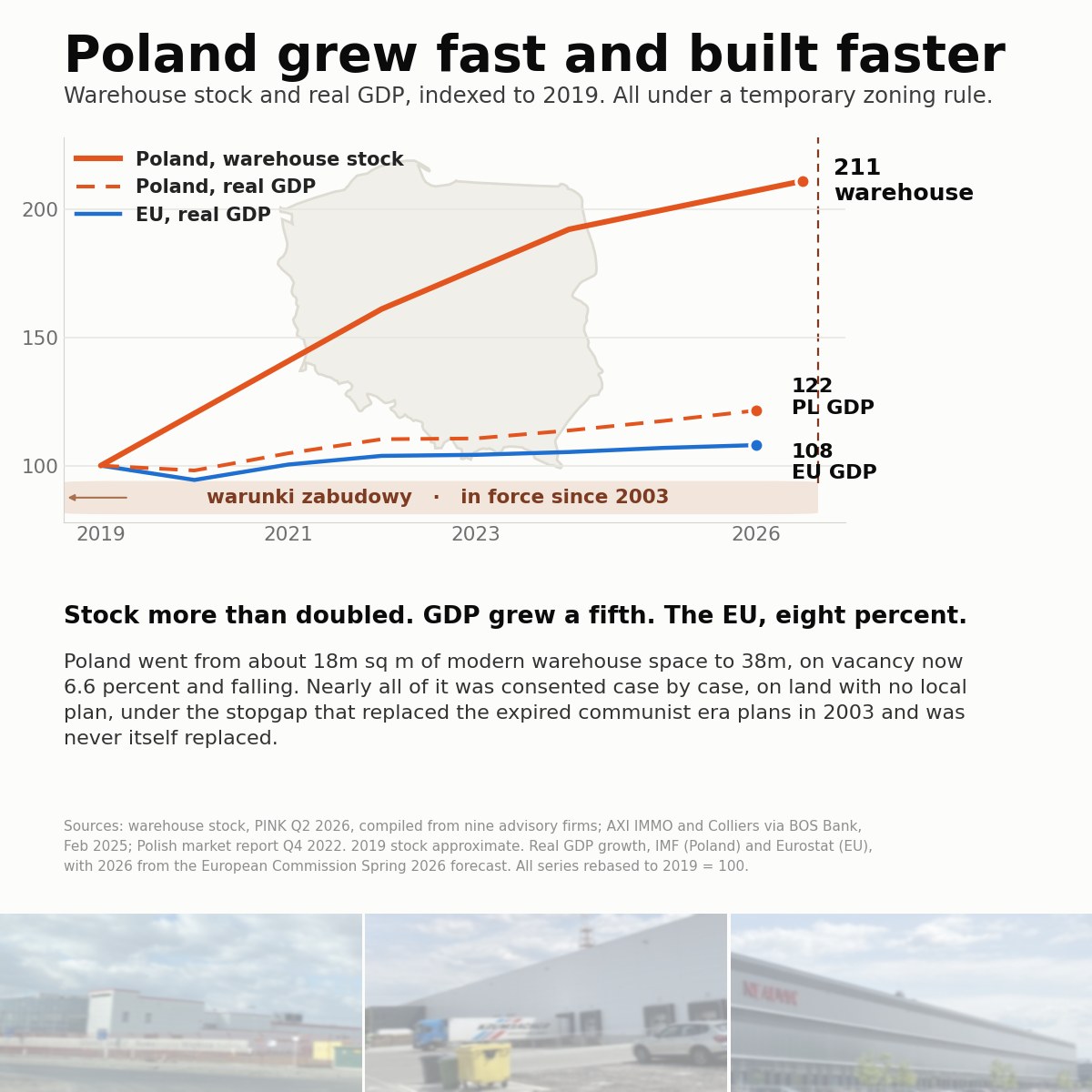
Poland has been the easiest place in Europe to build for 20 years. It's the only market here with a bit of that "US sunbelt" vibe, where even the most 'core' investors have learned, by caution or experience, to carefully check the free rent before believing anything they are told about the yield.
The economy reflects this too. Poland's projected 3.5% growth far outpaces the 1.1% of the EU, looks likely to continue, and no one is surprised anymore. And the relative ease of Polish zoning has been in place during all of this. But this week, that may have stopped.
Way back in 1994, a national planning act tried to sunset the old plans inherited from the communist era. Those plans covered most of the country, and they expired at the end of 2002. Poland did not replace them, and the 2003 act made "warunki zabudowy" the zoning route instead (ie., case by case zoning, with no local plan needed, about four months for a decision). It was meant to be a bridge.
A year and a half later, Poland joins the EU, then the motorways, German supply chain/automotive integration, e-commerce, nearshoring after 2022, and now whispers of defense spending. Warehouse space grew by up to 20 percent a year from 2004.
Poland now has 38m sqm, and GDP growth has outpaced the EU. They (and we) built the most new space in Europe and filled it, all while local plans only covered about a third of the country. What was meant to be a temporary bridge ran for 23 years, and that is what ended this week.
Every municipality now needs what the rest of us would call a zoning plan, covering all its land. Until it adopts one, it cannot issue new zoning decisions.
This is not a huge surprise. It has been in the works since 2023 and postponed twice. What made it stick this time is that the clock ran out. 31 Aug was the deadline for every milestone under the EU recovery fund, across the whole union, and Poland had about 8bn eur riding on it. It applies as a blanket to all development, including warehouses and manufacturing, and it will take a while to understand the implications. It might have a large impact, it might be small, and will likely vary across the country. But whatever the outcome, it is not likely to make building in Poland easier.
By contrast to some of Europe's other countries with strong assembly/manufacturing reputations, zoning in Germany can easily run 4 to 9 years for a new Bebauungsplan. In The Netherlands, permissions for floor area are down 42 percent since 2012, and that is before nitrogen/stikstof, and the grid (where an astonishing roughly 15,000 large users are queued for a connection). And anecdotally the Czech Republic might be the hardest of all.
And unlike line items like construction cost and land carry, 'time to entitlement' only rarely shows up in underwriting models. For the past 20 years, none of us have ever priced Poland's 'speed to zoning,' mainly because we got it for free without knowing it.
It might not be free anymore.