Four applicants, one grid connection
A data center, a cross-dock adding fleet charging, 400 homes and an LP are all waiting for the same thing. Four markets, four different answers.
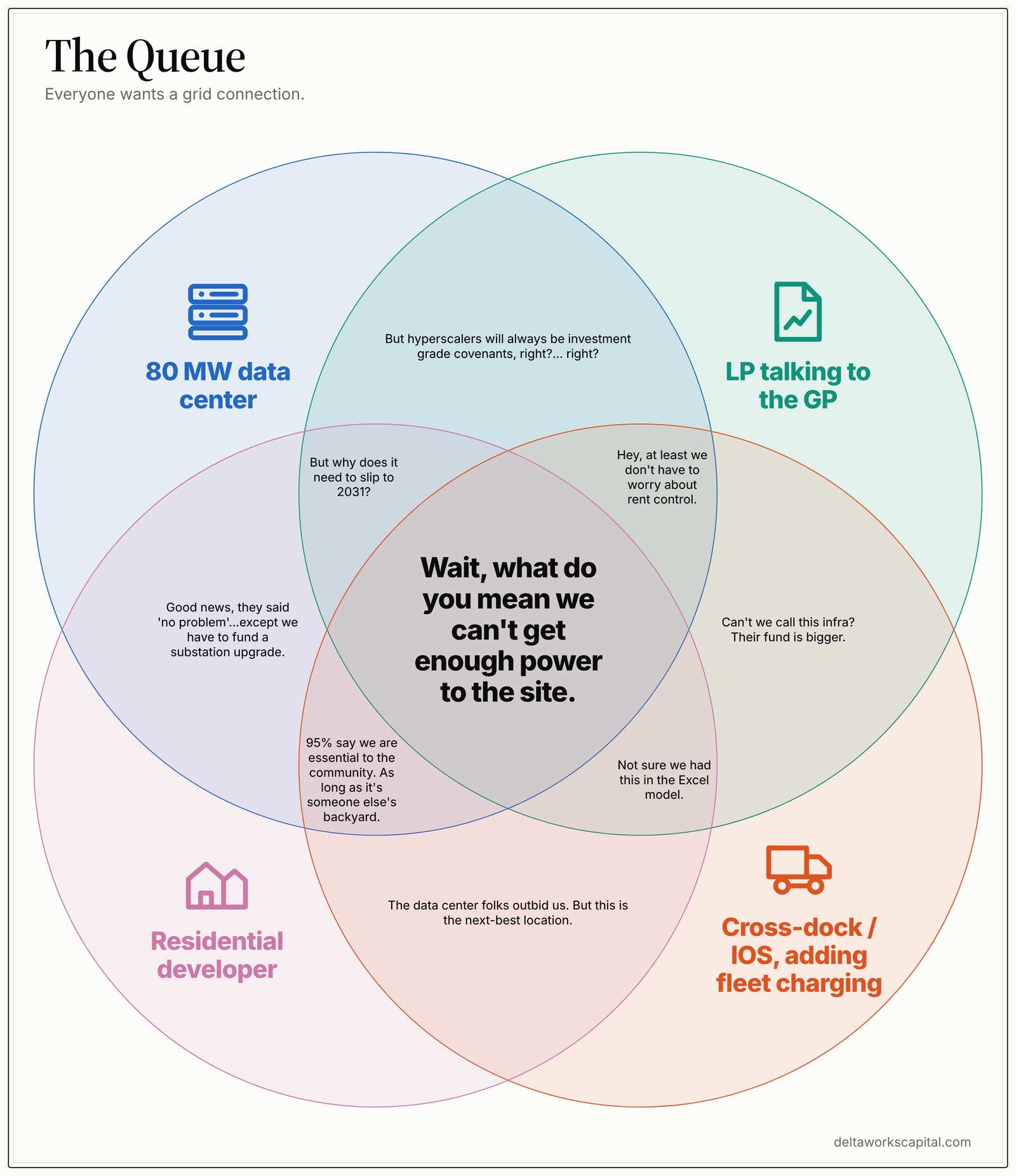
Anywhere and everywhere (except maybe in China), real estate people want more power. Pretty much everywhere, there is a queue.
Among others, I imagine that this queue contains:
- a horizontal land developer for an 80 MW data center
- a cross-dock/IOS operator who wants to add fleet charging
- a residential developer with a plan for 400 units/houses
- an LP addressing a real estate GP, who sold them on the fund as core-plus targeting low/mid teens
Every market has its nuances. The Dutch try to make everyone share, because they know new capacity is a decade out. The UK has turned standing in line into a kind of game. Ireland says yes, but you have to bring your own power plant. Even in Texas, you can connect to the grid, but then later on the spigot shuts off.
A lot of time is spent debating about which sector an asset belongs to. Logistics, Infrastructure, Residential, Digital. The electrons themselves don't really care, they just go to where the wires lead them. And if someone were to propose a battery farm to alleviate the situation, they would likely be encouraged and applauded, and then welcomed to join the line… at the back.
In short
- Why is there a queue to connect to the electricity grid?
- Because demand for large new connections has outrun the pace at which networks can be built. Data centres, electrified fleets, battery storage and housing all draw on the same network, and building new high-voltage capacity takes years of permitting and construction. Where the network is already at its peak limit, new or enlarged connection requests go onto a waiting list.
- How long is the wait for a grid connection in the Netherlands?
- About 14,000 companies were on the Dutch waiting list as of October 2025, a figure the climate minister gave to parliament. In Noord-Holland, TenneT expects waiting lists for large consumers for at least the next ten years, with the high-voltage grid fully extended by 2036 at the earliest. The interim answer is sharing rather than building: time-dependent transport rights let a customer draw power for a set share of the year in exchange for being curtailable the rest of the time. Applications for those rights exceeded 70 GW against 9.1 GW available.
- How does the UK grid connection queue work now?
- It is no longer first come, first served. Under the connections reform approved by Ofgem in April 2025, projects must demonstrate both readiness and alignment with strategic need to reach Gate 2 and hold a confirmed connection date and queue position. Projects that do not meet the criteria receive a Gate 1 offer with no confirmed date. The queue stood at over 738 GW against the 200 to 225 GW of clean capacity the system actually needs by 2030.
- Can data centres still connect to the grid in Ireland?
- Yes. The Commission for Regulation of Utilities decided on 12 December 2025 that a moratorium was not an appropriate or proportionate approach, superseding the 2021 direction for new applications. The condition is that a data centre of 10 MVA or more must provide dispatchable onsite or proximate generation or storage matching its import capacity, separately connected and metered and participating in the wholesale market, and cannot ramp to full capacity until that generation is delivered. At least 80 per cent of annual demand must come from additional Irish renewables on a six-year glide path.
- What happens to a large load in Texas after it connects?
- It can be curtailed. Texas Senate Bill 6, signed on 20 June 2025 and effective on signing, defines a large load as 75 MW or more and requires that loads interconnected after 31 December 2025 install equipment allowing ERCOT to directly curtail them during firm load shed events and emergencies. Critical load industrial customers and critical natural gas facilities are carved out. Connection is the permissive part; firmness is not guaranteed.
- Does it matter which sector an asset belongs to?
- Not to the network. Logistics, infrastructure, residential and digital assets queue on the same list and are assessed on the same constraint. The sector label determines which fund holds the asset, which hurdle it is underwritten against and which consultant advises on it, but it has no bearing on whether the connection exists. Where power is the binding constraint, the boundary between real estate and infrastructure stops describing anything real.