Where logistics real estate becomes infrastructure
In Europe and the United States they are separate asset classes, with separate funds and separate hurdles. In the Gulf that line was never drawn. A four month old freight corridor shows what the difference produces.
We spent thirty years separating real estate from infrastructure. Different funds, different hurdles, different consultants, property types and sub-types. Most people in this business can recite where the boundary sits without being able to defend it. The warehouse is real estate. The port is infrastructure. The road is public. The substation is somebody else's problem.
That division is an artefact of how capital organised itself. It is not a description of how freight moves. And the places where it fails first are worth watching, because they tell you what the assets are actually worth once the separation stops being useful.
Here is one. Have you heard of the Sharjah/Oman corridor? I had not either, until recently. Then again, it is only four months old, and it exists because of Hormuz.
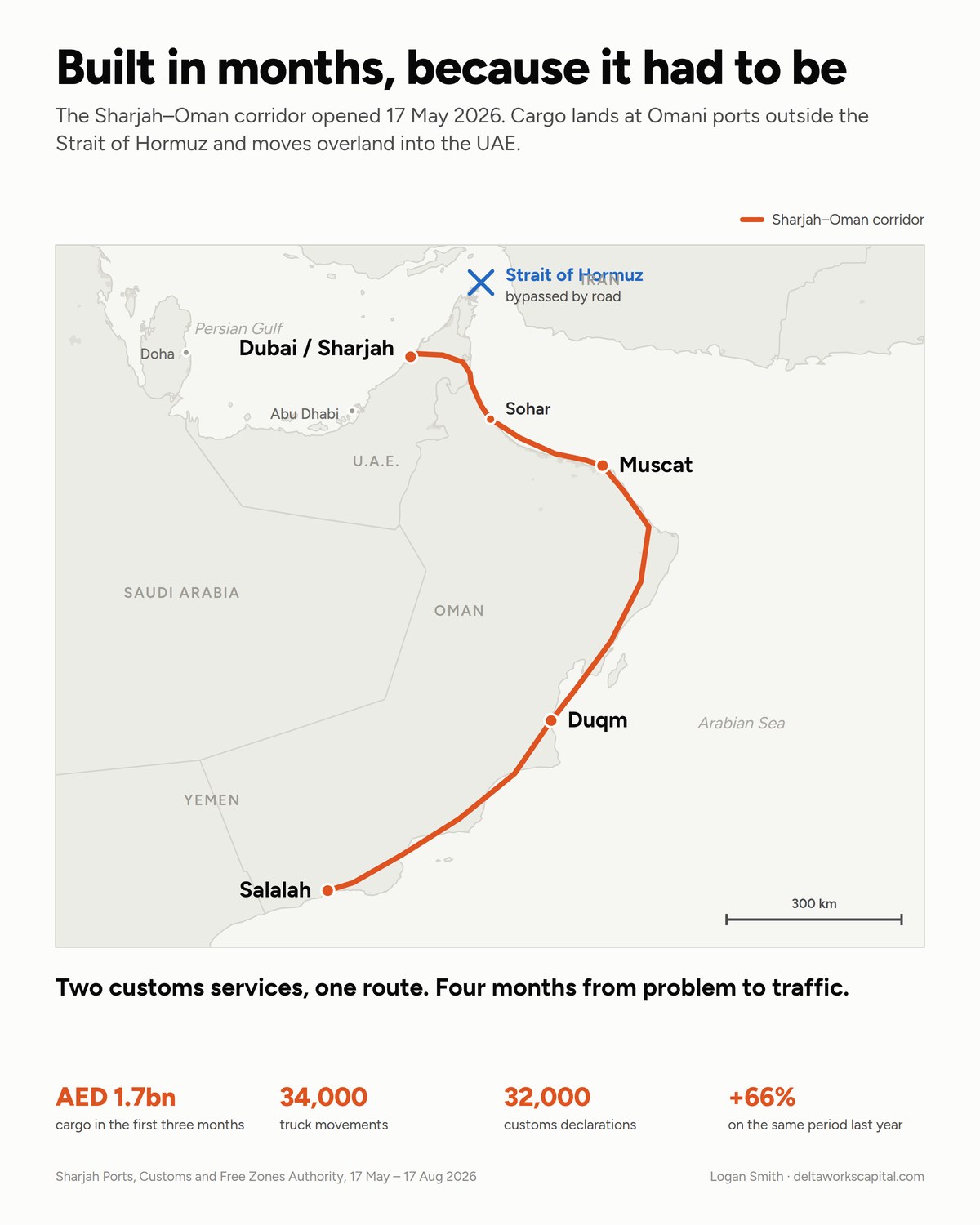
It opened on 17 May 2026, run jointly by the Sharjah Ports, Customs and Free Zones Authority and Oman Customs. Two land crossings, Khatmat Malaha at Kalba and Al Madam. Ports at Dubai and Sharjah at one end, inside the strait. Sohar, Duqm and Salalah at the other, on the Arabian Sea and well outside it. One route, one customs process, two countries.
In its first three months it moved AED 1.7bn of cargo, about $463m, across 34,000 truck movements and 32,000 customs declarations. Two hundred new importer codes were registered. Cargo value was up 66 per cent on the same period a year earlier.
The point of it is redundancy. The strait had been disrupted for roughly seven months. A box can now land at an Omani port and reach the UAE by road without a hull entering Hormuz at all.
It is a small road, and that is the argument
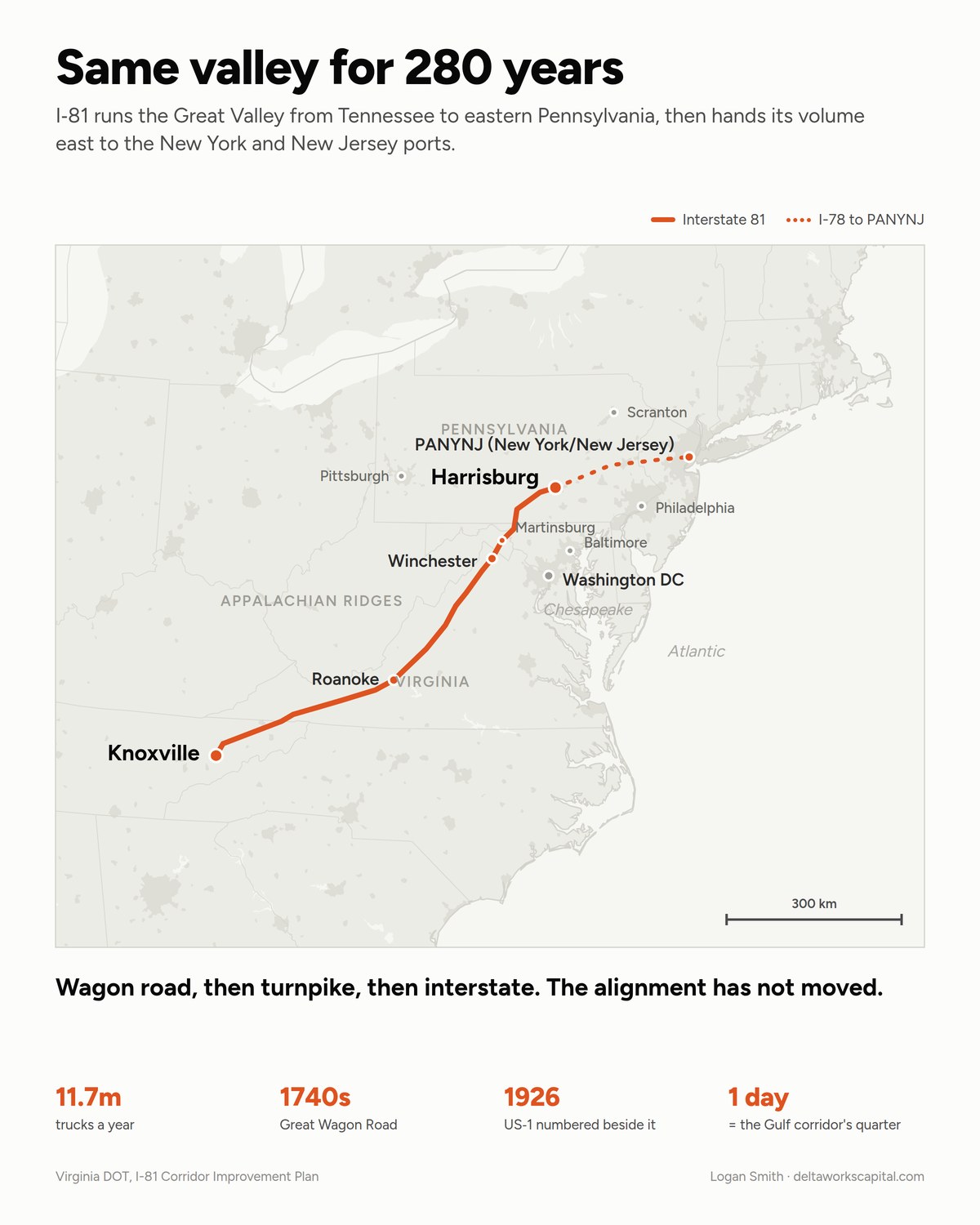
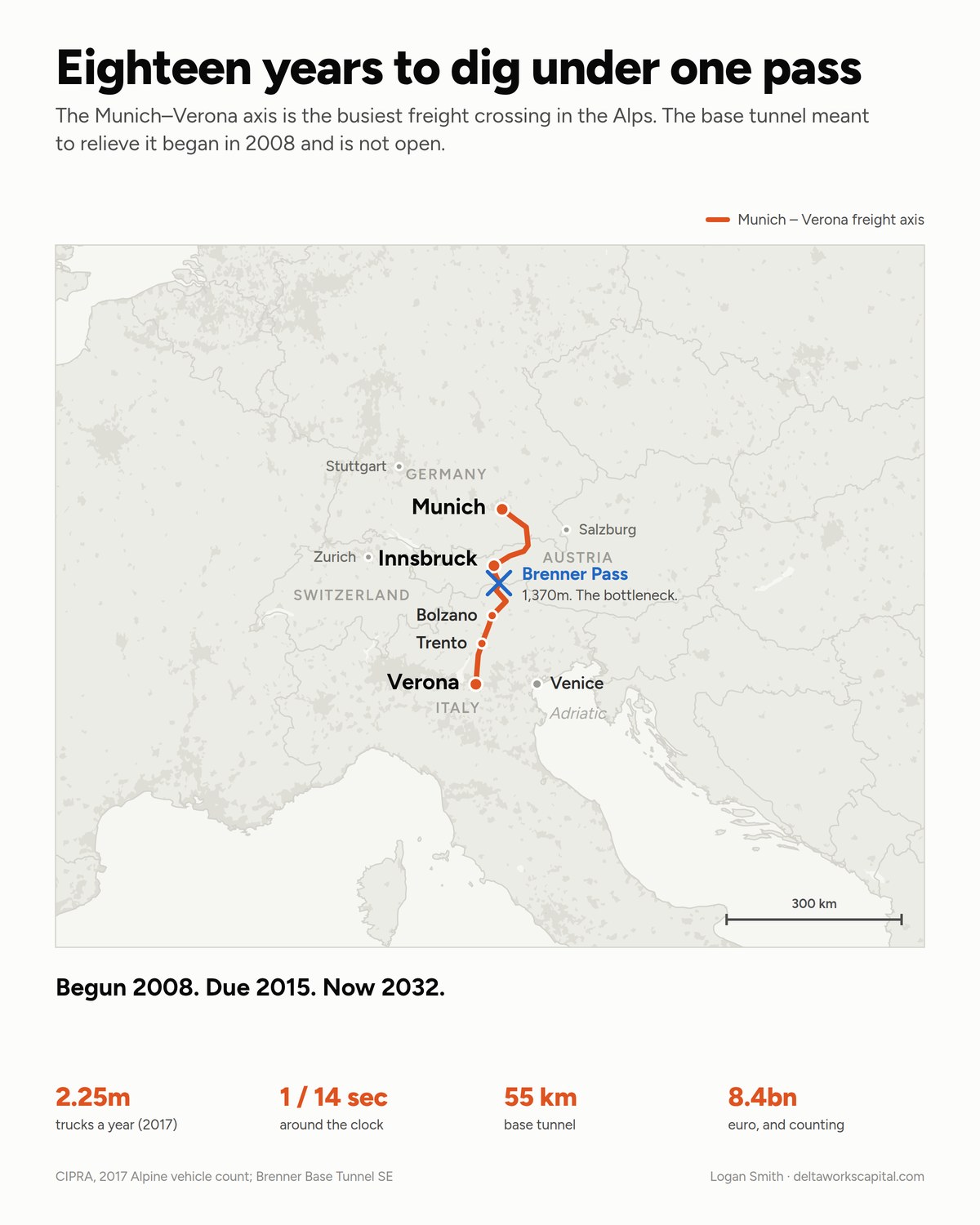
Be honest about the scale. Interstate 81 through Virginia carries 11.7 million trucks a year, which is about 32,000 a day. It moves in roughly one day what this corridor moved in three months. Over the Brenner, between Munich and Verona, a truck crosses every fourteen seconds, around the clock, all year.
So the corridor is not important because it is big. It is important because of how quickly it came to exist.
Compare the timescales rather than the volumes. Europe has been digging a 55km tunnel under the Brenner since 2008. It was meant to open around 2015. It is now scheduled for 2032, at something over eight billion euro. I-81 runs down the Shenandoah Valley, which has been the eastern seaboard's inland freight route since before the American Revolution; US-1 beside it was numbered in 1926, and the alignment has not meaningfully moved since. These are not bad projects. They are simply projects that take decades, because that is what they take.
The Sharjah/Oman corridor needed no masterplan, no private placement memorandum and no roadshow. A road, two border posts, a shared customs process, and ports at the far end that were already there. It was put together in months.
One intention
There is a stereotype in the West that some Gulf infrastructure is showy and inefficient. Sometimes that is earned. Not here, and the reason is structural rather than cultural.
In the Gulf, and I mean the UAE, Oman and Saudi Arabia, the port, the road, the customs regime and usually the leasehold under the warehouse sit inside one coherent industrial policy. Not necessarily under one owner, and not under one decision maker. Under one intention. When the sea lane became a problem, the people who could reroute around it were already in the same room, and none of them had to ask which asset class the answer belonged to.
Saudi Arabia is doing something comparable at another scale on its Red Sea coast, for the same reason.
That capacity, to make a route exist because it is needed, is what infrastructure investing actually is. Not an asset class. A capability.
The cost of integration
It cuts both ways, and any underwriter should say so. The same integration that produces a corridor in months produces concentration. One counterparty. Thin recourse. Ground lease tenor as a primary value driver rather than a footnote. An exit market that may consist of a small number of buyers who all answer to the same shareholder. Covenant analysis behaves differently when the tenant, the landlord and the regulator share a balance sheet.
Price it. Do not mistake it for the headline.
The same boundary, closer to home
Industrial outdoor storage is the clearest domestic example of the problem. Yards, trailer parking, container storage. All of it is functionally part of the freight system. All of it is priced as a land play, underwritten against real estate comparables, and held in a different fund from the port it serves. We drew that line ourselves and then charged ourselves for crossing it.
The Dutch grid queue is the same failure in a different costume. Thousands of businesses are waiting for a connection. Everyone can quote the length of the queue. Almost nobody quotes how much capacity actually got energised, because energisation sits with a utility and the building sits with a landlord, and no single model holds both.
What it does to land
Where the boxes land decides where the sheds go, on a lag usually measured in quarters rather than cycles. Sohar, Duqm and Salalah are picking up volume that used to price off Jebel Ali. Industrial land near those ports reprices when throughput shows up, not when the route opens.
Which leaves the real question for anyone underwriting it. Four months of data, no comparable series, and a route that exists because of a disruption that may or may not persist. If Hormuz normalises, does the corridor keep the volume or give it back?
My view is that it keeps most of it. Redundancy, once built and working, tends to stay in the routing. Shippers who have found a second way in do not usually hand it back.
In short
- Where do logistics real estate and infrastructure investing overlap?
- At the point where the value of a building depends on things the landlord does not own: the port it serves, the road to it, the customs regime that governs it, and the power under it. In Europe and the United States those sit in different funds with different hurdles. The separation is an artefact of how capital organised itself, not of how freight moves.
- What is the Sharjah–Oman logistics corridor?
- A joint road and customs route opened on 17 May 2026 by the Sharjah Ports, Customs and Free Zones Authority with Oman Customs, running through the Khatmat Malaha and Al Madam crossings and linking UAE ports with Sohar, Duqm and Salalah. First three months: AED 1.7bn of cargo, 34,000 truck movements, 32,000 customs declarations, up 66 per cent year on year.
- Why can the Gulf build freight infrastructure faster than Europe or the United States?
- Because the port, the road, the customs regime and often the leasehold under the warehouse sit inside one industrial policy. Not one owner and not one decision maker. One intention. Europe has been digging the Brenner base tunnel since 2008 for an opening now set for 2032. This corridor needed a road, two border posts and a shared customs process.
- What is the risk in integrated infrastructure of this kind?
- Concentration. One counterparty, thin recourse, and an exit market that may be a small number of buyers answering to the same shareholder. Ground lease tenor becomes a primary value driver. It is a real underwriting problem and it does not disappear because the route works.
- What does industrial outdoor storage have to do with it?
- IOS is the same boundary problem at home. Yards, trailer parking and container storage are part of the freight system but are priced as a land play and held in a different fund from the port they serve. The distinction was drawn by capital, not by the cargo.